

In public procurement, winning a contract is rarely just an exercise in demonstrating technical brilliance or presenting the lowest price. Public institutions (whether municipal authorities, federal agencies, or European Union bodies such as the European Commission, DG CONNECT, or the European Defence Agency) operate under rigid administrative and legal frameworks. In this environment, a bid can feature groundbreaking innovation, yet face disqualification during preliminary screening if an administrative declaration is omitted, a formatting limitation is exceeded, or a mandatory technical specification goes unanswered.
A compliance matrix serves as the operational blueprint that bridges complex government solicitations with structured, winning proposal responses. By systematically parsing, indexing, and cross-referencing every stipulation contained within tender specifications, the compliance matrix protects bidding consortia against inadvertent disqualification, streamlines multi-partner workflows, and provides procurement evaluators with an unmistakable roadmap to score your proposal favorably.
The Imperative of Compliance in Public Tendering
Government procurement differs fundamentally from commercial B2B sales. Commercial buyers often overlook omitted details if the overarching value proposition is compelling. Public contracting authorities cannot afford such leeway. Bound by legal mandates governing transparency, equal treatment, and public accountability, such as the EU Public Procurement Directives (Directive 2014/24/EU) or national procurement acts, evaluators must adhere strictly to the rules established in the tender documentation.
Under these frameworks, evaluation teams carry out a sequential review:
- Admissibility and Administrative Compliance: Verifying that the tenderer meets formal submission criteria, deadlines, language requirements, and statutory exclusions (e.g., European Single Procurement Document/ESPD or exclusion grounds).
- Technical and Professional Selection Criteria: Assessing minimum economic, financial, technical, and professional capacity thresholds (pass/fail).
- Award Criteria Evaluation: Scoring substantive award criteria based on the Most Economically Advantageous Tender (MEAT) formula, balancing technical excellence with price.
If a tender fails at the first stage, it never reaches the qualitative scoring phase. Evaluators reviewing hundreds of pages under strict deadlines depend on structural clarity. Misplaced sections, unaddressed clauses, or ambiguous phrasing force evaluators to spend unnecessary time hunting for evidence, introducing scoring risks or immediate compliance rejections. The compliance matrix eliminates this risk by converting sprawling solicitation dossiers into an auditable, tracked operational workflow.
Deconstructing the Compliance Matrix: Core Components
A standard compliance matrix is not a mere checklist; it is an active database mapping tender obligations to proposal sections, assignees, and verification evidence.
| Column Header | Operational Purpose | Example (EU Context) | Example (General/Federal Context) |
|---|---|---|---|
| Tender Reference | Direct clause, paragraph, or annex citation from the tender specifications. | Tender Specifications §2.3.1 (Task 1: System Integration) | Section L.3.2 (Management Approach) |
| Requirement Description | Direct extract or precise paraphrase of the buyer's requirement. | "Bidder must guarantee ISO 27001 certification and GDPR-compliant local data hosting within the EEA." | "Provide management approach for contract performance" |
| Requirement Type | Category: Administrative, Exclusion, Selection, Award/Scoring, or Technical SLA. | Mandatory Selection Criterion (Pass/Fail) | Technical Evaluation Factor |
| Proposal Section & Page | The exact volume, section, heading, and page number in your submitted proposal. | Volume 1 (Technical Offer), Section 2.1, pp. 14–18 | Proposal Section 3.1 (Management Approach) |
| Lead Owner / Contributor | Designated author, subject matter expert (SME), or consortium partner responsible. | Partner B (Cloud Architect Lead) | John D. |
| Verification & Evidence | Necessary artifacts, certificates, CVs, or tables demonstrating compliance. | Valid ISO 27001 certificate in Annex 4; Data Center Tier III audit report | Staffing matrix, signed letters of commitment |
| Status | Real-time drafting status throughout the proposal lifecycle. | In Review (Pink Team) | In Progress |
| Cross-References / Notes | Relevant interactions with pricing volumes, assumptions, or tender clarifications. | Clarification Question #4 confirmed hybrid hosting is permissible; align with Price Schedule line 3. | Align with staffing plan |
Step-by-Step Methodology: Building an Auditable Blueprint
Developing a robust compliance matrix requires a methodical approach that starts the moment the contract notice is published.
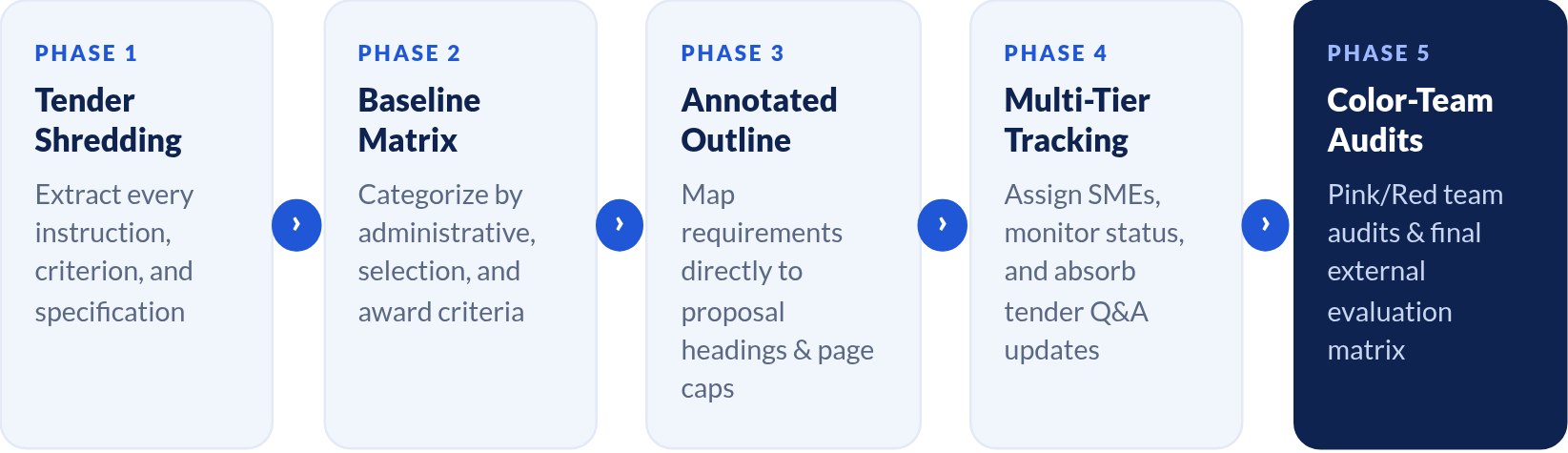
Step 1: The "Tender Shredding" Process
Do not rely on executive summaries or call overviews. A designated bid manager or compliance lead must systematically review every document in the tender package:
- Tender Specifications / Terms of Reference (ToR): The technical statement of work defining service levels, deliverables, and timelines.
- Invitation to Tender / Submission Instructions: The procedural rules dictating volume splits, font sizes, page limits, signature protocols, and electronic portal mechanics (e.g., e-Submission via EU Funding & Tenders Portal).
- Evaluation & Award Criteria: The qualitative and economic scoring grid, including relative weightings and scoring minimums.
- Draft Contract & Special Conditions: Standard administrative clauses, penalties, intellectual property rules, and warranty terms.
Identify operational imperatives by searching for modal verbs: "shall", "must", "will", "should", "is required to", and "failure to comply will result in rejection". Every sentence containing an explicit or implicit obligation must be isolated and logged into the baseline matrix.
Step 2: Establish the Structural Hierarchy
Organize the matrix to reflect the evaluator's scoring mindset:
- Administrative & Exclusion Requirements: Gathering declarations of honor, tax certificates, anti-corruption statements, power-of-attorney documents, and consortium agreements.
- Technical & Financial Capacity (Selection Criteria): Confirming minimum turnover requirements, professional indemnity insurance, client references from previous contracts, and core staff qualifications.
- Award Criteria (Qualitative Scoring): Substantive methodology, architecture, implementation schedules, risk management, and quality control procedures.
- Contractual & Commercial Terms: Adherence to liability caps, standard SLAs, price breakdowns, and indexation mechanisms.
Step 3: Map into an Annotated Proposal Outline
Do not begin drafting substantive paragraphs in a blank document. Instead, convert the compliance matrix directly into an annotated proposal outline. If Requirement 4.2 asks for a "Business Continuity and Disaster Recovery Plan within 4 hours RTO," create a section in your proposal draft with the exact title: Section 4.2: Business Continuity and Disaster Recovery Plan.
Maintain the buyer's numbering and terminology. Evaluators score tenders against an evaluation sheet modeled directly on the tender specifications. If they have to search through a creative narrative to determine where your Disaster Recovery strategy is hidden, you risk losing evaluation points.
Step 4: Consortium Allocation and Ownership
Public tenders, particularly major EU framework contracts, are frequently pursued by consortia composed of multiple vendors, academic partners, and specialized SMEs. In these setups, compliance failure often stems from interface boundaries: Partner A assumes Partner B is providing the security accreditation, while Partner B assumes it falls under Partner A’s scope.
The compliance matrix makes ownership explicit. Every line item must have a named author and a designated reviewer. For multi-partner bids, add columns indicating which consortium member is providing the supporting documentation or drafting the response.
Step 5: Incorporate Dynamic Tender Clarifications
During the tender window, bidders submit clarification questions, and authorities issue formal amendments, corrigenda, or question-and-answer batches. In EU public procurement, these clarification notes possess legal weight and regularly amend or soften core requirements.
A static matrix creates vulnerability. Whenever the contracting authority releases a clarification log:
- Scan for alterations to deadlines, specifications, or allowable formats.
- Trace the affected line items in the matrix.
- Update the requirement summary, cross-reference the Corrigendum number, and alert the assigned author immediately.
Navigating European Union and International Nuances
While compliance fundamentals apply across international public sectors, bidding within the European Union ecosystem introduces specific nuances that must be reflected in the compliance matrix.
Administrative Screening: The ESPD
For European public tenders governed by EU directives, the European Single Procurement Document (ESPD) acts as preliminary self-declaratory proof of financial standing, capability, and lack of exclusion grounds (such as bankruptcy, corruption, or unpaid social security contributions).
- In your matrix, break down each section of the ESPD (Parts II through VI) into distinct validation lines for the primary contractor and every consortium member or subcontractor relied upon.
- Ensure certificates (e.g., extracts from judicial records, tax balance certificates) are valid within the exact validity window stipulated by national or EU law.
The Dual-Matrix Strategy: Internal vs. External
In sophisticated bidding, the compliance matrix serves two distinct functions:
- The Internal Production Matrix: A granular tracking instrument used by the bid team to manage SME drafting, page counts, consortium inputs, review cycles, and risk notes.
- The External Evaluation Cross-Reference Matrix: A refined, customer-facing table submitted as part of the formal proposal package (often placed right after the table of contents or in an introductory chapter).
The external matrix directly mirrors the tender specifications' evaluation grid. It lists each evaluation criterion, the corresponding tender paragraph, the exact proposal section, and a concise 1–2 sentence compliance summary highlighting your value proposition. This structural aid allows the public evaluator to cross-reference every tender criterion against your text without friction.
Strict Separation of Technical and Financial Offers
Under EU procurement rules, where the tender documents require separate technical and financial envelopes, price details placed in the technical envelope can lead to disqualification, to preserve objective evaluation. Your matrix must classify each line item by submission envelope (e.g., Envelope A: Administrative, Envelope B: Technical, Envelope C: Financial), preventing technical authors from mentioning pricing figures or day rates within the technical narrative.
Integrating the Matrix into Review Cycles (Pink and Red Teams)
A compliance matrix is not a set-and-forget document created during kickoff and filed away until submission. It serves as the primary auditing tool during formal review gates, most notably the Pink Team and Red Team milestones.
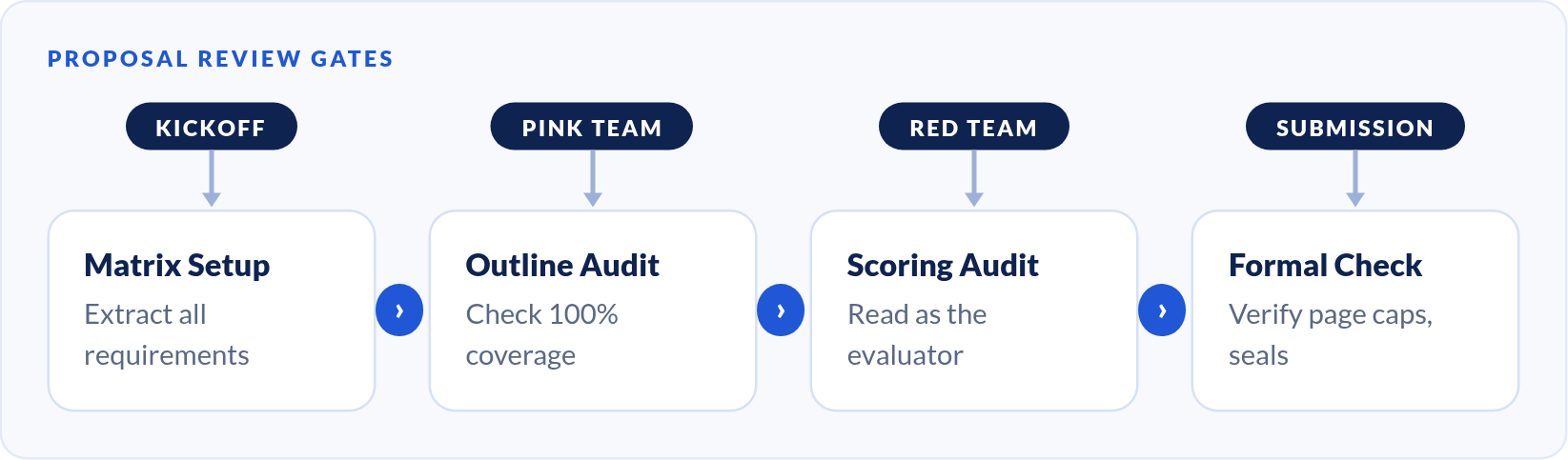
The Pink Team Review (Concept and Outline Validation)
Held when sections are roughly 30% to 50% drafted, the Pink Team’s primary role is to verify structural alignment. Reviewers use the compliance matrix to ensure:
- Every mandatory requirement has a dedicated, clearly identified proposal section.
- Authors have understood the true intent of the tender specification.
- Page-count allocations are balanced relative to the evaluation criteria weighting.
The Red Team Review (Evaluation and Scoring Simulation)
Held at the 85% to 90% completion mark, the Red Team acts as the government evaluation committee. Red Team reviewers should be handed the tender specifications, the evaluation sheet, and the draft proposal. They use the compliance matrix to:
- Verify that every stated requirement is not just addressed, but evidenced.
- Check that terminology matches the tender vocabulary precisely.
- Identify any non-compliant statements, unapproved caveats, or conditional language (e.g., "we assume", "subject to negotiation") that could trigger administrative rejection.
Common Pitfalls and Mitigation Strategies
Proposal teams frequently encounter recurring compliance failures that undermine otherwise competitive bids.
| Common Pitfall | Mitigation Strategy |
|---|---|
| Neglecting Administrative & Formatting DetailsIgnoring instructions like font sizes, page limits, or file-naming rules. | Treat margin sizes, page caps, fonts, and naming rules as pass/fail criteria in the matrix. |
| Losing Track of CorrigendaFailing to update requirements after formal clarifications or amendments. | Assign a compliance lead to log and trace all tender amendments and Q&A batches. |
| Inconsistent Proposal MappingDifferent authors interpret or locate technical responses in different places. | Enforce strict outline control; forbid section moves without compliance approval. |
| Over-Engineering the MatrixCreating overly complex formats that teams avoid updating. | Stick to essential operational columns so the team actively maintains it under pressure. |
1. Over-Engineering the Matrix
Teams sometimes construct tracking systems with dozens of redundant metadata fields, resulting in a matrix so cumbersome that writers bypass it.
2. Treating Compliance as Purely Negative
Teams often view compliance merely as "avoiding disqualification," leading to flat, uninspired proposals that answer questions with a perfunctory "yes, we comply."
3. Administrative and Formatting Neglect
A bid team can spend three weeks perfecting a technical architecture, only to have an SME submit a 40-page section where the strict limit was 25 pages, or submit documents without mandatory electronic signatures (e.g., Qualified Electronic Signatures/QES under the eIDAS regulation in the EU).
The Linchpin of Public Sector Growth
A proposal cannot win on compliance alone; technical suitability, strategic value, robust methodologies, and pricing competitiveness ultimately decide the award. However, technical excellence is irrelevant if a proposal is disqualified at the administrative hurdle or penalized by evaluators unable to find answers within a disorganized document.
Developing a comprehensive, actively managed compliance matrix transforms public tender management from a reactive exercise into a structured, predictable discipline. By enforcing accountability across consortium partners, guiding writers through structured outlines, and providing government evaluators with a transparent path to award points, the compliance matrix functions as the indispensable operational blueprint for winning government business.